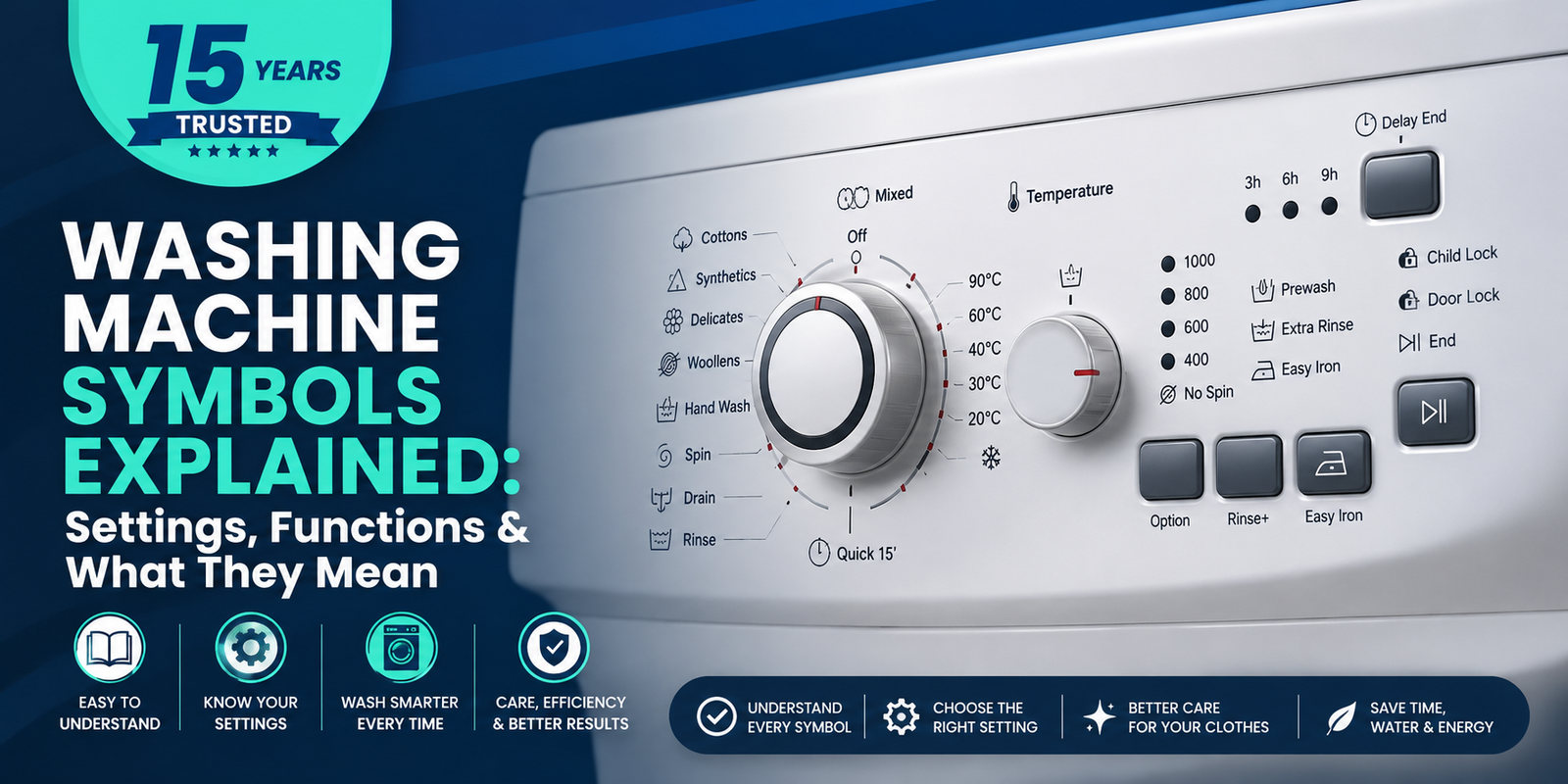
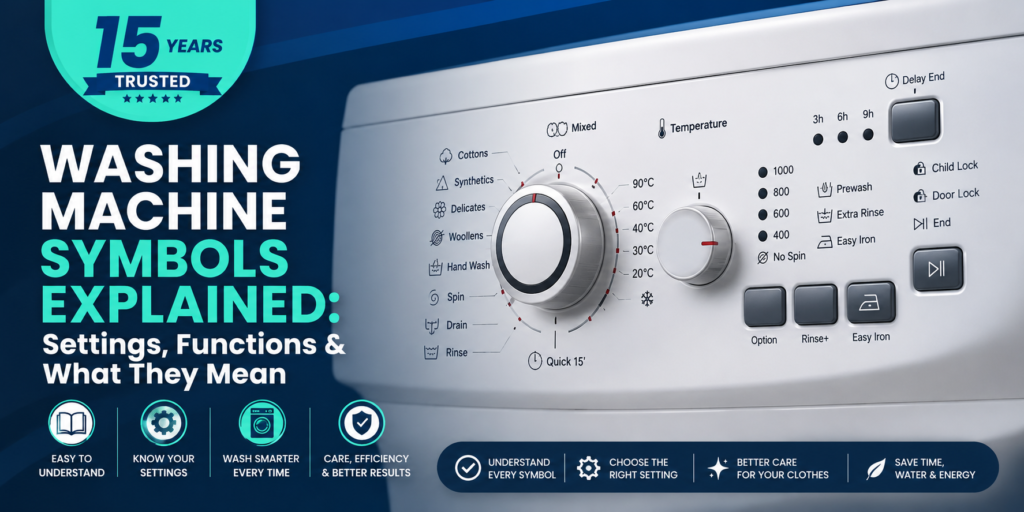
Washing Machine Symbols Explained: Every Icon On Your Dial, Decoded
You’re standing at the washing machine, basket of clothes on your hip, staring at a dial full of tiny pictures that mean absolutely nothing to you. A leaf. A moon. Something that might be a shirt, or might be a ghost. Sound familiar?
You’re not doing anything wrong. Washing machine symbols were designed to save space on the control panel, not to be obvious. Even people who’ve owned the same machine for years still guess half the time.
This guide has washing machine symbols explained in plain English — no manual required, no guesswork, no washing your favourite jumper on the wrong cycle ever again.
Table of contents
- Why washing machine symbols exist in the first place
- Washing machine symbols explained: the main wash cycles
- Spin speed and temperature symbols explained
- Function and extra option symbols explained
- Detergent drawer symbols explained
- How to find the best washing machine symbols explained guide for your brand
- Mistakes people make with washing machine symbols (and how to avoid them)
- Frequently asked questions
- Sources and further reading
1. Why washing machine symbols exist in the first place
Here’s the thing nobody tells you: washing machine symbols aren’t random. They follow a rough international pattern, which is why a Bosch and an LG look more similar than different once you know what to look for.
Manufacturers use icons instead of words for two reasons.
- Space. A control panel is small. Words in six languages wouldn’t fit.
- Universality. A picture of a shirt means “cotton clothing” whether you read English, French, or nothing at all.
The catch is that nobody sat you down and taught you the icon language. So even though the symbols make sense once explained, most people are left guessing at the worst possible moment — right before laundry day.
That’s really the whole point of this article. Once you’ve read it, you won’t need to guess again.
A quick heads-up before we dive in: this guide covers the icons you’ll see on the vast majority of machines sold today. If your model is unusual or older, a couple of symbols might differ slightly — we’ll show you exactly where to double-check that in section six.
2. Washing machine symbols explained: the main wash cycles
This is where most of the confusion lives, so let’s slow down here.
Cotton
Usually shown as a simple shirt or tub icon, sometimes labelled “Cotton” outright. This is your everyday, heavy-duty cycle — longer wash time, stronger agitation, made for things that can handle a proper scrub.
Use it for:
- T-shirts and everyday clothes
- Towels
- Bedsheets
- Underwear
Delicates
Often a shirt icon with a flower, feather, or thinner outline next to it. This cycle is gentler on every level — lower temperature, slower spin, softer drum movement.
Use it for:
- Silk and lace
- Lingerie
- Delicate blouses
Wool
A little wool-ball or sheep icon. It’s specifically tuned to avoid shrinking and felting, which is the nightmare scenario with wool.
Even so, always check the garment’s care label first — some wool items genuinely can’t go anywhere near a machine.
Eco
A leaf, or the word “ECO” inside a tub symbol. It runs longer than you’d expect, but it uses less water and less energy, which matters if you’re washing several loads a week.
Jeans
A denim/trouser outline. Built for heavy cotton fabric — enough agitation to actually clean, but a controlled spin to reduce fading.
Quick Wash
A stopwatch, or a number like “15” or “30.” Perfect for a small, lightly soiled load when you need something clean in a hurry — not the cycle for muddy sports gear.
Night Wash
A crescent moon. Quieter drum movement, gentler spin, made so you (or your neighbours) aren’t kept awake.
Mixed Load
A shirt icon with a mixed pattern, or the word “MIX.” This is your safe middle ground when you’re washing cotton and synthetics together and don’t want to sort everything into three piles.
Sport / Activewear
A sneaker or dumbbell icon. Built for gym gear and technical fabrics — gentler wash action than Cotton, with extra rinsing to shift sweat and odour without damaging performance materials.
Easy Iron
A shirt with a curved line, sometimes labelled Permanent Press or Anti-Crease. It reduces spin speed and softens the wash action specifically so shirts and uniforms come out with fewer creases to iron out later.
Synthetics
A triangle or square-shaped fabric icon. Gentler than Cotton but sturdier than Delicates — the right middle ground for polyester, nylon, and blended fabrics.
Between these ten or so icons, you’ve genuinely got 90% of your laundry covered. The rest of this guide fills in the smaller details.
3. Spin speed and temperature symbols explained
These two symbols work together, but they control different things — worth understanding separately.
Spin speed
Shown as a spiral or swirl, usually next to an RPM number (revolutions per minute).
| Spin speed | Best for |
|---|---|
| 800 RPM | Delicates |
| 1000–1200 RPM | Everyday clothing |
| 1400 RPM+ | Towels, bedding |
Higher RPM pulls more water out, which means shorter drying time — but it also means more creasing on soft fabrics. If you’re on a delicate cycle, drop the spin speed too, not just the temperature.
Temperature
A tub with wavy lines, or a thermometer, usually alongside a degree number.
- Cold — delicates, dark colours
- 30°C — everyday clothing
- 40°C — mixed loads, standard cottons
- 60°C — towels, bedding, heavily soiled whites
- 90°C — sanitising towels and workwear
A short rule of thumb: the dirtier and hardier the fabric, the higher you can go.
Why the two symbols are often confused
People frequently mix up spin and temperature because both symbols can appear as a swirl or a tub with lines. The easiest way to tell them apart: temperature symbols almost always show a number with a degree sign or dots representing heat levels, while spin symbols show a number followed by “RPM” or just a bare number in the 400–1600 range.
If your dial only shows one number and you’re not sure which it is, check whether it climbs past 100 — temperatures rarely go above 95°C, so anything higher is spin speed.
4. Function and extra option symbols explained
Beyond the main dial, most machines have a row of smaller buttons for extra functions. These are the ones people tend to ignore completely, which is a shame, because a couple of them solve real problems.
Delay Start
A clock icon. Lets you schedule the wash to start later — handy for off-peak electricity, or timing a cycle to finish right when you get home.
Prewash
Usually a tub with a small “+” symbol. Adds a short wash before the main cycle, which is genuinely useful for muddy kids’ clothes or heavy workwear.
Extra Rinse
Two droplets, or “+RINSE.” Adds a rinse pass — good if you have sensitive skin, or if you tend to use more detergent than the load actually needs.
Drum Clean
A circular arrow or droplet inside a drum shape. This runs a maintenance cycle to clear out detergent build-up, bacteria, and that musty smell that creeps in over time. Run it monthly if your machine gets daily use.
Child Lock
A small padlock. Disables the panel so buttons can’t be knocked or pressed mid-cycle — a genuinely useful safety feature in a house with kids.
Drain
A downward arrow into a tub. Empties the drum of water without spinning — useful if a cycle got interrupted partway through, or if you just need the machine emptied before moving it.
Rinse
Often shown as a droplet or wave icon on its own. Runs a rinse-only pass, separate from Extra Rinse, which is more useful when you’ve hand-washed something and just need the excess suds removed.
A quick note on all of these: most people only ever use two or three function buttons regularly, and that’s completely fine. The rest exist for the occasional situation where they genuinely save you a headache — worth knowing they’re there, even if you rarely press them.
5. Detergent drawer symbols explained
This is the one everyone forgets exists, and it causes more washing problems than people realise.
Open the drawer and you’ll usually see three sections:
- “I” — pre-wash detergent (only fill this if you’ve selected Prewash)
- “II” — main wash detergent (this is the one you use almost every single time)
- Flower icon — fabric softener
Put detergent in the wrong slot, and it either gets released at the wrong point in the cycle or doesn’t get used at all. If your clothes have ever come out with white streaks or still smelling less than fresh, this drawer is worth a second look before you blame the machine itself.
6. How to find the best washing machine symbols explained guide for your brand
Here’s something worth knowing: not every brand uses identical icons. The core shapes are similar, but small design details shift between manufacturers.
A search for “best washing machine symbols explained” usually turns up general guides like this one, which is exactly the right starting point — they teach you the underlying logic once, so you’re not relearning it every time you buy a new machine. But general guides can only take you so far when your specific dial has a symbol that looks slightly different from what’s described here.
If you want the best washing machine symbols explained specifically for your machine, here’s the fastest path:
- Check the model sticker first. It’s usually on the inside of the door or the back panel, and it tells you exactly which manual applies.
- Search “[brand] + [model number] + manual” rather than a generic search — this pulls the manufacturer’s own PDF, which shows the exact icon set for your unit.
- Compare against a general guide like this one to understand the underlying logic, then confirm the specific icon shape against your manual.
Brands like Bosch, LG, Samsung, Electrolux, Miele, Fisher & Paykel, Speed Queen, and Westinghouse all follow the broad pattern covered above, with minor stylistic differences — so once you understand the categories, brand-hopping isn’t nearly as confusing.
What if my machine shows an error code instead of a symbol?
Error codes are a different beast entirely — they’re not about which cycle to choose, they’re the machine telling you something’s gone wrong. Codes like OE, 5E, or SE on LG and Samsung machines, E20 or E21 on Electrolux and Westinghouse, or F05 on Fisher & Paykel usually point to a blocked filter, a struggling drain pump, or a kinked hose.
If a symbol is flashing alongside a code, that’s the machine narrowing down the problem for you — worth checking the manual for that specific code rather than guessing at a fix.
7. Mistakes people make with washing machine symbols (and how to avoid them)
A few patterns show up again and again:
- Guessing instead of checking. A wrong guess on Wool or Delicates can genuinely ruin a garment. Thirty seconds with the manual is cheaper than a shrunk jumper.
- Ignoring the detergent drawer. As covered above, this causes more washing complaints than people expect.
- Never running Drum Clean. Skipping this leads to smell and residue build-up over months, not days — so it’s easy to not notice until it’s a real problem.
- Overloading on Quick Wash. This cycle is built for small, lightly soiled loads. Stuffing a full basket in and expecting a deep clean isn’t realistic.
- Assuming every brand is identical. Close enough to guess the category, not close enough to assume the exact temperature or RPM defaults.
- Mixing up spin and temperature. As covered in section three, these two get confused constantly — a quick glance at whether the number is a degree or an RPM figure sorts it out fast.
- Washing wool on Cotton “just this once.” It rarely ends well. Wool fibres felt and shrink at temperatures and agitation levels that Cotton settings are specifically designed to use.
None of these mistakes are really about being careless — they’re about a control panel that was never properly explained in the first place. Now that it has been, they’re easy to avoid going forward.
8. Frequently asked questions
Do all washing machines use the same symbols?
Most brands follow a similar pattern, but the exact icon design can vary. If you’re ever unsure, your model’s manual is the most reliable source.
What’s the best everyday setting?
Cotton, Mixed Load, or Eco will comfortably cover most everyday laundry without much thought.
Is Eco mode actually better for my clothes and bills?
It uses less water and energy, though the cycle typically takes longer to finish. Worth it for regular loads, less so if you’re in a rush.
What does the spiral icon mean?
That’s your spin symbol. It controls how fast the drum spins to remove water before the drying stage.
I searched “washing machine symbols explained near me” — is there someone local who can just tell me?
Totally understandable instinct, but you don’t need a technician for this one. Every symbol is standardised enough that a written guide like this (paired with your specific model’s manual) will answer it faster than booking someone out. Save the technician call for when something’s actually broken — a leak, a drum that won’t spin, or water that won’t drain.
9. Sources and further reading
For brand-specific icon confirmation, manufacturer manuals are the most reliable source:
- Bosch Australia — bosch-home.com.au
- LG Australia — lg.com/au
- Samsung Australia — samsung.com/au
- Electrolux Australia — electrolux.com.au
- Miele Australia — miele.com.au
A final word
Washing machine symbols explained properly stop being intimidating almost immediately — they’re really just a compact visual shorthand for a handful of repeatable categories: fabric type, temperature, spin, and a few extra functions layered on top. Once those categories click, every new machine you own gets easier to read, not harder, because you’re recognising a pattern instead of starting from scratch.
If your machine is showing the right symbols but still isn’t cleaning, draining, or spinning properly, that’s usually a parts issue rather than a settings one — worth sorting sooner rather than later, before a small fault turns into a bigger repair.